
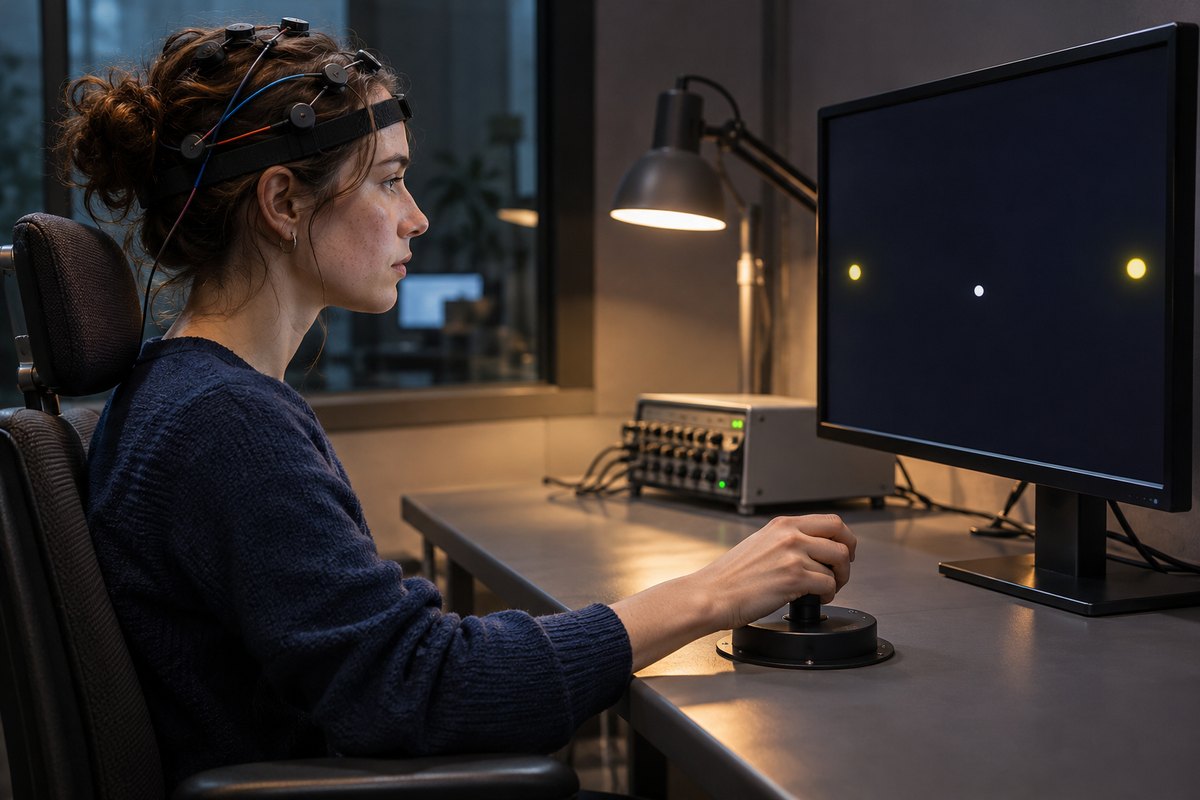
Ten signals flash at the edge of a screen. A volunteer catches all ten and presses a button half a second after each one. Another volunteer also averages half a second, but catches only six. If the report publishes only mean reaction time for correct responses, the two performances look identical. The four events that might interest us most have vanished from the arithmetic.
This imaginary example captures a real difficulty in measuring attention after THC. A person can respond promptly whenever they notice something and still miss more of what happens around them. Researchers make that difference visible by assigning two jobs at once, then recording what happens to each. A display, a moving target and a signal off to one side are enough to give someone’s attention two places to be.
Keeping a moving target under control
Tracking is a continuous job. As a marker drifts, the volunteer corrects its position. Researchers can measure the distance between the desired position and the actual one, or record occasions when the participant loses control altogether. Those summaries favor different aspects of performance. Several small errors spread across a minute can produce a similar average deviation to one large excursion followed by an excellent recovery.
The second task interrupts that work. A target appears among peripheral signals, demanding a response while the tracking continues. A scorekeeper can now ask three questions about the same stretch of time. How well did the marker stay on course? How many targets did the volunteer detect? How quickly did they respond to the ones they saw? Doing well on one measure can come at a cost to another if the participant gives one task priority.
In a laboratory study by Theunissen and colleagues, occasional and heavy cannabis users completed divided-attention testing under THC and placebo. Control losses and the number of correct detections helped distinguish responses across the two groups. The evidence for a group difference in reaction-time response was less clear. Reporting the three measures separately preserves a distinction that a single label such as “slower thinking” cannot convey.
Why the setup can change the result
Even the size and layout of the display are design choices. Researchers developing phone-based tests of acute THC effects had to ask how well short tasks on a small device could register changes in performance. An easy tracking task may leave time to spare for the occasional flash. A fast, unstable marker might absorb most of that time even before anyone takes a drug. Two labs can both claim to test divided attention and still pose different challenges. Training matters as well. Once a volunteer has learned how strongly the control responds, a second attempt can improve simply through familiarity. Placebo sessions under comparable conditions help researchers distinguish that practice from a drug effect.
A systematic review of controlled THC research examined differences across cognitive and driving outcomes, routes of administration and times since exposure. Such a review can test whether a pattern recurs beyond one apparatus or one group of volunteers. It also inherits the distinctions in the original measurements. Averaging several experiments that measured response time cannot recover the missed signals if the experiments never reported them.
Bringing the task closer to a road
A randomized trial of edible cannabis in a driving simulator tracked lane position, speed and reaction time. A driver could choose a lower speed, wander within a lane or respond late to an event. One number on the speedometer would say little about the other two. The simulator resembles everyday driving more closely than a marker on a display, though a lab trial still measures performance along a specified route under specified conditions.
For a reader, one detail in the methods section is especially revealing: which opportunities to respond made it into the final score? A mean calculated across correct button presses tells you how fast a response came once the signal got through. The list of missed targets tells you how often a response never came. On a crowded screen, that silence is a measurement in its own right.