
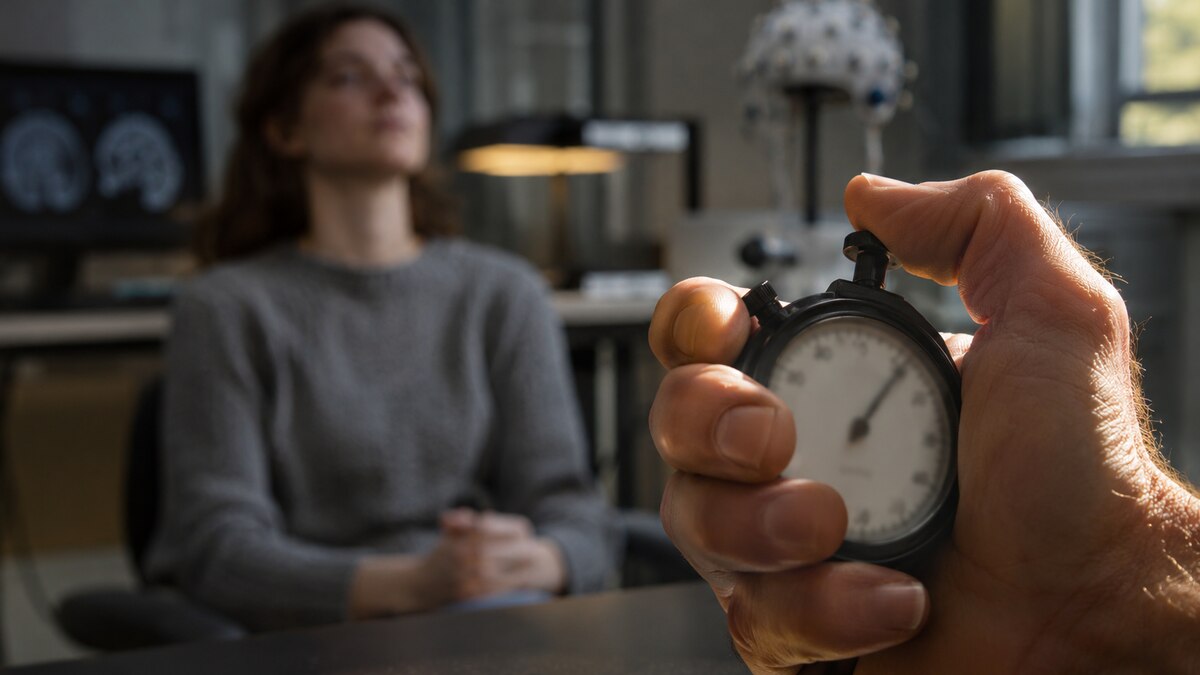
Ask someone to sit quietly for half a minute. Then put the clock out of sight and ask a slightly different question. How long did that last? In the first exercise the person decides when to stop. In the second you decide, and the person has to put a number on the experience. Two instructions that sound interchangeable at the kitchen table turn out to be a particularly good way of studying THC.
Counting up and calling time
Imagine that twenty seconds pass and a volunteer guesses twenty-five. The interval has been overestimated. Now ask that volunteer to signal when twenty seconds have gone by. If the signal comes at sixteen seconds, the volunteer has underproduced the interval. The errors point in opposite directions on paper. As descriptions of experience, though, they fit together rather nicely. In each case the volunteer behaves as though more time has elapsed than the clock records.
These numbers are illustrations. In the controlled study by R. Andrew Sewell and colleagues, 44 people performed visual timing tasks in the seconds range under THC and placebo. The investigators found the combination of overestimation and underproduction under THC. Their published methods and figures make clear how far the experimental question is from asking people whether an evening felt long. Each judgment had an external beginning, an end and a correct answer.
Why use both tasks?
A person who simply prefers large numbers might overestimate every interval. That habit alone would give little reason to expect an early button press on the production task. Getting the two results together makes the interpretation more interesting. It still leaves room for several explanations. Volunteers have to pay attention to the signal, keep the instruction in mind and decide when their impression is strong enough to justify an answer. An experimenter sees the answer at the end of that chain. An earlier experiment on cannabis and temporal information processing asked participants to produce intervals without counting, a rule that matters if a volunteer normally keeps time by silently repeating numbers.
What an internal clock would have to explain
The image of a clock running fast is appealing. Suppose an internal counter usually accumulates one mark per second and suddenly accumulates more. When asked how much time has passed, its owner would report a larger number. When asked to wait for a particular number of marks, the same person would stop early. This is a model with a testable prediction. Nobody in the experiment had a device that counted those hypothetical marks inside the brain.
The distinction becomes important when two studies seem to disagree. One may ask volunteers in advance to keep track of time. Another may surprise them with the question after an absorbing activity. The second group must reconstruct a duration from what it remembers about the activity. A critical review of cannabis and time perception found considerable variety in the methods used across the literature. Across timing research more generally, a meta-analysis of cognitive load examined how demands on attention change duration judgments. Knowing what people were doing with their attention is part of knowing what their estimates mean.
A minute in whose hands?
Sewell’s team also distinguished frequent cannabis users from people with less experience. The timing effects were clearer among the less frequent users. That difference invites an explanation involving tolerance, but a comparison between people with different histories cannot establish precisely how the difference arose. Nor does a group average tell you whether a particular person’s next estimate will be early or late.
A final wrinkle comes from the word “slow.” If someone’s internal count raced ahead, an outside observer might describe the clock as fast. The person waiting for a real clock to catch up might say that time had slowed to a crawl. Both descriptions could refer to the same sixteen-second button press. The virtue of a laboratory task is that it can dispense with that argument altogether. It records who controlled the interval, what the volunteer believed had happened and what the clock on the wall actually said.