
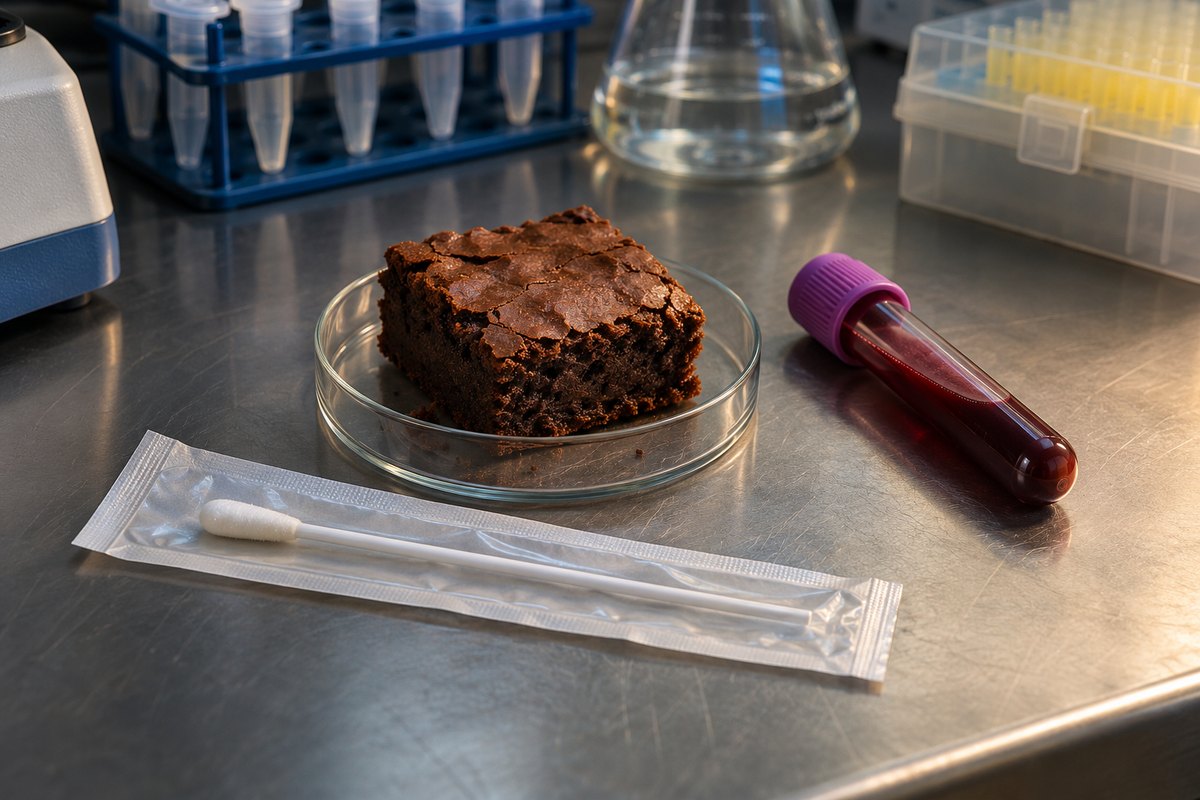
Of all the samples collected after somebody eats a cannabis brownie, the first swab of the mouth might contain the most THC anyone will measure in that person’s saliva all day. The person may barely feel anything yet. A piece of the explanation is sitting in plain sight. Before a brownie reaches the stomach, it has already been in direct contact with the inside of the mouth.
Ryan Vandrey and colleagues followed these events in a controlled study of oral cannabis. Adults consumed brownies containing measured quantities of THC. Over the hours that followed, the researchers collected blood and oral fluid, asked how participants felt and assessed performance. Plotting the results against the same horizontal axis produced several markedly different curves. Their peaks would give quite different answers to the deceptively simple question of when the drug was at its strongest.
The swab gets a head start
Oral fluid contains material from around the mouth. Soon after eating, that can include THC left locally by the food itself. In the brownie study, average peak oral-fluid THC concentrations occurred about twelve minutes after consumption in each of the three dose groups. The early concentrations were much higher than those recorded in whole blood. A high number here is entirely compatible with relatively little THC having reached the circulation at that moment.
The units look invitingly comparable. The lab can express both results in nanograms per milliliter. Yet a milliliter of fluid collected in the mouth and a milliliter of blood drawn from a vein have different histories. Converting one to the other would require a predictable relationship between them. Direct contact with the brownie introduces a local source that a blood sample does not share. A precisely calibrated instrument can measure that difference without being able to subtract it away.
A second timeline in the blood
As a review of oral THC preparations describes, swallowed THC travels through the digestive system. During absorption it passes through the liver, where some is converted into 11-hydroxy-THC, itself psychoactive. A blood analysis can distinguish the original molecule from that metabolite and from further breakdown products. Their concentrations rise and fall at different rates. In the two higher-dose groups, average whole-blood THC peaked a little over two hours after ingestion, much later than the early oral-fluid peak. Individuals within the same group differed considerably.
A group peak needs careful reading. Suppose one participant’s highest sampled value occurs at an hour and another’s at four hours. An average gives a concise summary, although it may describe neither person’s experience particularly well. And a sample collected on the hour tells us what the concentration was then. A sharper peak somewhere between two draws might go unrecorded. The researchers’ timetable helps define the curve we eventually see.
How it felt, and how a task went
Participants in the study generally reported effects beginning about half an hour to an hour after eating, well after oral-fluid THC had peaked. In a placebo-controlled follow-up with infrequent users, researchers again found delayed subjective effects. Different amounts also produced different patterns of task performance. Reporting a noticeable effect and showing a measurable change on a particular test were separable outcomes. Each deserves its own line on the graph.
A later randomized driving-simulator trial makes the practical distinction clearer. Researchers tested performance at specified intervals after an edible and measured such things as lane control. That design answers what the driver did on the task at that time. A saliva swab cannot reconstruct those steering movements, and one blood value alone cannot recreate the sequence of events leading up to it.
A useful way to read any result from an edible study is to put three labels beside the number: what material was sampled, how long after ingestion, and what else was measured at the same visit. Twelve minutes after a brownie, a swab may tell a remarkably clear story about recent contact between food and mouth. The participant’s experience is still unfolding.